
View Lost Cats Near Gray, ME

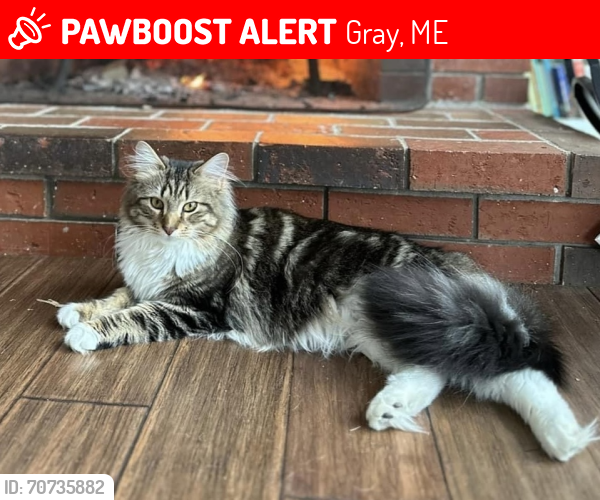
Mabel is Missing in Gray, ME

Share on

Status

LOST

Date Last Seen

September 6, 2024

Location Last Seen

Gray, ME 04039

Nearest Landmark

Rustic Rd Gray, ME

Name

Mabel

Sex

Female

PawBoost ID

70735882

Microchip #

941010001387680

Species

Cat

Description

Mabel is one year old. She has long hair and an extremely fluffy tail. She is an indoor/outdoor kitty.

Message from Owner

Help us find our sweet Mabel! We miss her

Facebook Community Response

Marta W.
1 month ago
I found her around my compound Center Rd, ME 04039, please message me now
Reply
Diane C.
2 years ago
Prayers🙏🐾
Reply
Kris M.
2 years ago
🙏🙏🙏🙏
Reply
Carol S.
2 years ago
🙏🙏🙏🙏🙏🙏🙏
Reply
Rosemary B.
2 years ago
Mabel is very pretty hope she’s found soon good luck 🍀
Reply
Helen E.
2 years ago
Post on Maine Lost Cat Recovery
Reply
Martha H.
2 years ago
HOW TO RECOVER A DISPLACED CAT Missing Pet Partnership Any cat (indoor-only or outdoor access) can become displaced. In general, any cat that is transplanted into unfamiliar territory is a DISPLACED CAT. If your cat becomes displaced there is good news -- your cat is probably not “lost” at all! That is because it is likely that your cat is hiding and, depending upon the terrain, he/she is probably closer than you think. The majority of these cases involve indoor-only cats that accidentally escaped outdoors; however, outdoor-access cats can become displaced into unfamiliar territory as well, like when they escape from their carrier while at the vet's office, escape from an RV while traveling on vacation, or escape from a vehicle during a car accident. We've even discovered that some outdoor-access cats can become displaced when they are chased from their territory (usually by another cat or a loose dog) and can be just a few houses down, hiding in a neighbor's yard. While some of these cats may adapt after a few days and work up the confidence to return home, many become disoriented and are afraid to come home. Thus, normally confident, friendly outdoor-access cats can be hiding in fear within a close proximity to their own home. This is why a physical search (by you) of your neighbor’s yards is critical! WHY DISPLACED CATS HIDE - When an indoor-only cat escapes outside (or when any cat is displaced into an unfamiliar area), the cat is likely hiding (usually near the escape point) in fear. That is because cats are territorial and your cat's territory was inside of your home. Once a cat is transplanted into unfamiliar territory, it seeks shelter because it is afraid. Cats that are afraid (and cats that are injured) will seek areas of concealment such as under a deck, under a house, under a porch, or in heavy brush and they will not meow! Meowing would give up their location to a predator. Their behavior has nothing to do with whether the cat loves you, whether it recognizes your voice, or whether it can smell you--it has everything to do with the fact that a panicked cat will hide in silence! So just because you do not see or hear your cat does NOT mean that he/she is not very close to home. HUMANE TRAPS - The method that Missing Pet Partnership has pioneered that has resulted in the recovery of thousands of "missing" indoor-only cats (and displaced outdoor-access cats) is the same method used to capture feral cats--the use of a humane cat trap. We call this "trap-and-reunite" or "TAR." Humane traps have a trip mechanism that when triggered by a cat (or other small animal), will shut the door and contain a cat inside. These wire cages are sold in hardware stores (usually as traps used humanely capture raccoons) or available at some vet offices. WILDLIFE CAMERAS – In some cases, Missing Pet Partnership recommends the use of digital wildlife cameras before you start trapping, especially in cases where a cat is displaced in an apartment complex where there are zillions of cats, in areas where there are many raccoons, or in other situations where a humane trap would be difficult to use. The concept is that you set out a plate of cat food along with a motion-activated wildlife camera overnight. The camera will snap photos of all the animals that eat that food so that when you come back the next morning, you can pull the SD card from the camera, put it in your computer, and see photos of raccoon, raccoon, raccoon, CALICO! THERE IS MY CAT! From that point, you’d work to strategically humanely trap your cat while avoiding the raccoons and other cats. Call your towns Animal Control Officer or local shelter about the best way to humanely trap a displaced cat. ONE MORE THING – Many cats, especially skittish cats, hide in silence and require time before they enter a humane trap. While some cats take only hours or a few days to catch, others take several days (sometimes ten to twelve days) before they respond to food and enter a trap. Do NOT get discouraged if you’re setting traps but not catching your cat initially, especially if he has a skittish temperament!
Reply

More Lost & Found Pets Near Gray, ME

More Lost Pets in Your Area
Pawboost White Dog Hero

JOIN THE

RESCUE

SQUAD

The Rescue Squad™ is a group of 7,594,432 pet lovers who have signed up for local lost & found pet alerts.

Join The Rescue Squad™

Contact Owner