
View Lost Cats Near Ballston Spa, NY

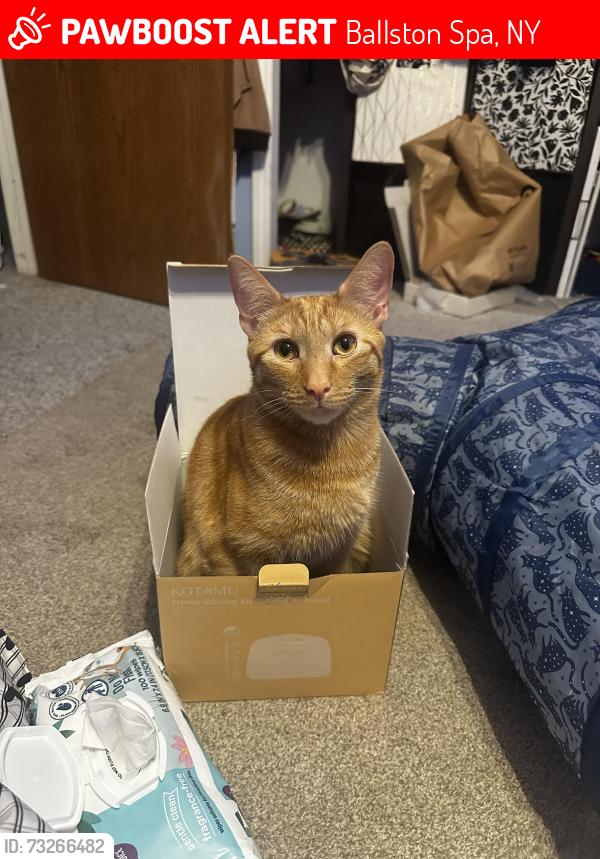
Flynn is Missing in Ballston Spa, NY

Share on

Status

LOST

Date Last Seen

August 15, 2026

Location Last Seen

Ballston Spa, NY 12020

Nearest Landmark

Milton oaks development

Name

Flynn

Sex

Male

PawBoost ID

73266482

Species

Cat

Description

Small male cat 2 years old , orange tiger cat with stripes on head and sides, light goldish/ yellow eyes

Message from Owner

Please help me find my cat he’s never been outside and he unexpectedly got out , he’s super sweet but skittish to people he doesn’t know . He’s my baby please help me.


Comments on this Facebook alert

Deirdre G.
9 hours ago
Trap & camera are key!!! Our boy was finally trapped after 45days! Seen almost nightly on camera. Local the entire time!! Don’t give up! CHECK GARAGES ETC!!
Reply
Linda T.
13 hours ago
Please don't lose heart if your cat has been missing for a while. My own cat got out when we had company over. He was gone for almost three weeks. I did everything I knew to do. I searched, put up flyers with a $50 reward, and posted him on the Nextdoor neighborhood app. People began communicating and watching for him. Eventually, a young woman who worked about four blocks from my house noticed a tuxedo cat outside her office window. He kept crying there, and she began feeding him. She happened to mention the cat to her mother. Her mother had seen my post on Nextdoor. They contacted me, and this wonderful young woman actually kept my cat safely with her until I could get there and bring him home. That is why I tell people: KEEP LOOKING, KEEP POSTING, AND KEEP TALKING TO PEOPLE. Communication can be what brings your cat home. I was trying absolutely everything while he was missing. I even grilled fish outside late at night and tried using the smell of sardines around my property. My neighbors probably thought I had lost my mind! 😊 I didn't know then about putting familiar bedding or worn clothing outside, which is another scent idea people sometimes use. When I finally got my boy back, he had been through a lot. He was frightened, stressed and didn't even seem like himself at first. It took about a week before he relaxed and settled back into being himself. But he came home after almost three weeks. So please don't assume that because days—or even weeks—have passed that you're not going to find your cat. Keep searching. Keep putting up flyers. Keep posting and reposting. Keep asking people to watch. Keep following up on sightings. And keep praying. Please don't lose heart. It can take time.
Reply
Linda T.
13 hours ago
https://share.google/wlDFSK06W9t23VEob
Reply
Linda T.
13 hours ago
So if you are helping someone whose indoor cat has escaped, I'd change the advice to something like: Don't rely on the litter box. Instead, physically search very close to the escape point, slowly and repeatedly, especially under porches, decks, sheds, bushes, crawl spaces, cars and other tiny hiding places. Use a flashlight because frightened cats often remain completely silent even when their person calls them. Put familiar bedding or the owner's worn clothing near the entrance rather than urine/feces. Some animal organizations recommend this as a familiar scent cue without the territorial implications of litter. � SPCA of Northern Virginia Use strong-smelling food strategically with a camera and/or humane trap, rather than simply leaving food out indefinitely. Unmonitored food can also bring raccoons, other cats and wildlife. � Humane Society of Charlotte +1 If safe, provide access through the door/window or other entrance the cat knows, particularly during quiet nighttime hours. � Humane Society of Charlotte Now, there's one thing I'd push back on in the anti-litter-box argument too. You'll sometimes see people state as established fact that “litter attracts predators that will attack your cat.” That's stronger than the evidence warrants. The Missing Animal Response Network itself says the territorial-cat concern has not been proven in a scientific study. It's a behaviorally plausible risk, not an established experimental finding. � Missing Animal Response Network So the fairest conclusion isn't “litter boxes are dangerous.” It's: There's no convincing evidence that putting the litter box outside helps, there's a plausible downside, and there are substantially better-supported things to spend your effort on. And I think there's actually a useful modification of your original instinct: you were right to think familiar scent may have value; I just wouldn't choose urine and feces as the scent source. I'd choose the cat's bedding/blanket and the owner's worn clothing near the familiar entrance, while putting most of the effort into an extremely thorough close-range physical search. That last part is probably the biggest thing worth spreading in the lost-cat groups. People tend to imagine a missing cat wandering blocks or miles away. For a terrified indoor cat, “he may be silently hiding under your neighbor's deck 100 feet away” is often a much more productive mental model. �
Reply
Linda T.
13 hours ago
https://share.google/wlDFSK06W9t23VEob
Reply
Trudy C.
1 day ago
Omg so precious! Sharing ❤️🐈‍⬛
Reply
Ann D.
1 day ago
Missing Indoor Cat Indoor cats that get out are usually terrified and rarely travel far. They almost always hide silently in a 3 to 5 house radius, often freezing in place. Your most actionable steps are to conduct physical searches at night using a bright flashlight and to set out food and familiar scents. It is incredibly stressful when an indoor cat gets out, but take a deep breath. Because indoor cats aren't used to the outdoors, their instinct is usually to hide in fear nearby rather than run away. Here is a strategic, step-by-step checklist to help you bring your kitty home safely. 1. Search the Immediate Area (The "Radius of Fear") Most indoor cats hide within a 3 to 5-house radius of where they escaped. They are likely terrified and hunkered down in a dark, quiet spot. * Check your own yard first: Search under porches, decks, stairs, inside crawl spaces, in dense bushes, under cars, and in wheel wells. * Ask neighbors to check their surveillance cameras. * Think like a cat: Look in tiny gaps you think they couldn't possibly fit into. Check gutters, sheds, and trash bin areas. * Search at prime times: The best times to look are dawn, dusk, and late at night when the world is quiet. Cats feel safer moving around in the dark. Look up! Into trees! * Shake their favorite treats: Walk slowly, shake a treat bag, or tap a wet food can. Talk in a calm, normal, reassuring voice so you don't sound panicked. 2. Use Scent to Guide Them Home Cats have an incredible sense of smell. You can use familiar scents to create a "lighthouse" effect back to your house. * Set out their litter box: Place their used litter box outside near the door they escaped from. The scent can drift quite far and guide them back. * Deploy unwashed laundry: Put out a dirty shirt you’ve worn, or their favorite blanket/bedding. * Set out smelly food: Put out strongly scented food (like warmed-up wet food or tuna) nearby, but keep an eye on it so it doesn't just attract wildlife or neighborhood strays. 3. Set Up a Safe Entry Point * Leave a door cracked: If it is safe and possible, leave the door they slipped out of slightly open. Many cats will try to sneak back inside in the dead of night when they think no one is watching. * Use a humane trap: If you know they are nearby but too scared to come out, borrow or buy a humane "Have-a-Heart" trap. Bait it with highly fragrant food (like sardines) and cover it with a familiar blanket. Check it frequently. 4. Spread the Word Digitally Act quickly to get the community looking out for your cat. * Post on local apps: Nextdoor and local Facebook Groups (search for your city/neighborhood "Lost and Found Pets") are incredibly effective. * Use lost pet databases: Post on websites like PawBoost, Pet Fbi, and the Lost Cat Finder. * Check microchip info: If your cat is microchipped, call the registry immediately to ensure your contact information is up to date and flag them as lost. 5. Physical Flyers & Local Alerts Don't underestimate the power of old-school paper flyers. * Make a clear flyer: Include a bright, clear photo, the cat’s name, description, your phone number, and the date/intersection where they went missing. Keep the text large and readable from a car. * Talk to neighbors: Ask your immediate neighbors for permission to check their yards, under their decks, and in their garages. * Notify local shelters: Call and visit local animal shelters and humane societies. Physically go there if you can, as descriptions of cats can vary wildly from person to person. * Alert local vets: Let nearby veterinary clinics know, in case someone finds your cat and brings them in to be checked for a chip. A Quick Word of Encouragement: Indoor cats are incredibly resilient. It is very common for them to hide silently for days—even ignoring your calls—before finally breaking cover when hunger takes over. Stay persistent, keep searching at night, and don't lose hope.
Reply
Renee B.
1 day ago
Prayers for a return 🙏❤️🙏
Reply

Help this alert reach more local people Help more people see this pet

Share this Facebook post with nearby friends, neighborhood groups, or anyone who may recognize Flynn. The more people share and engage with it, the more Facebook will show it to others nearby.

Open Facebook PostOpen Post
Post link https://www.facebook.com/LostPetsNewYork/posts/1479364647552109
Pawboost White Dog Hero

JOIN THE

RESCUE

SQUAD

The Rescue Squad™ is a group of 7,657,771 pet lovers who have signed up for local lost & found pet alerts.

Join The Rescue Squad™

Contact Owner