
View Lost Cats Near Vancouver, WA

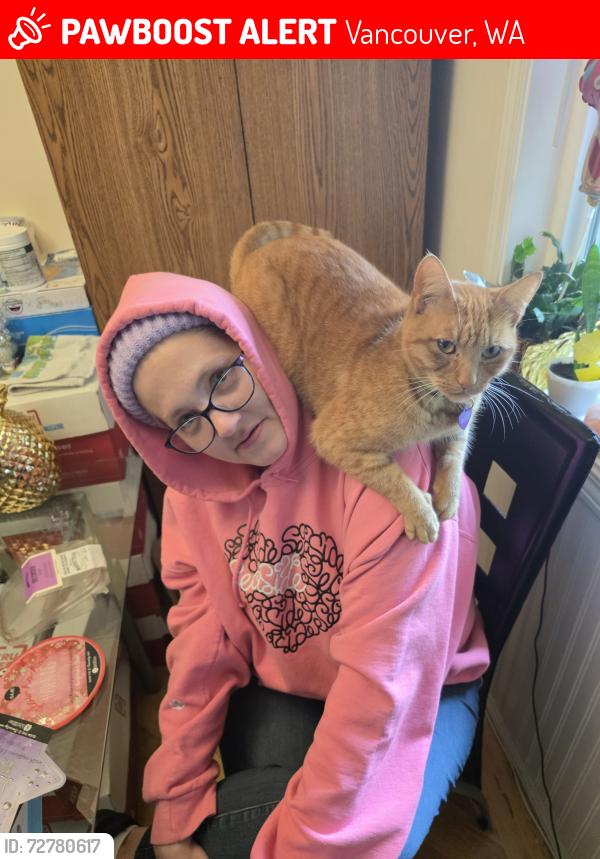
Mango is Missing in Vancouver, WA

Share on

Status

LOST

Date Last Seen

April 14, 2026

Location Last Seen

Vancouver, WA 98664

Nearest Landmark

104th & Ellsworth

Name

Mango

Sex

Female

PawBoost ID

72780617

Species

Cat

Description

Missing orange female cat

Message from Owner

Please bring my baby . My family misses her she is very loved and missed by all of us. Contact me for my contact info and pictures


Facebook Community Response

Lydia T.
1 month ago
Stressful! Please be open to many possibilities. Most 'lost' cats are hiding (or locked in / trapped, prevented from returning home), frightened (especially if chased or injured), possibly disoriented, within about 500 metres from where lost. (Less for indoor cats). Some cats fear making a noise, in case it attracts predators, so might not respond to your calls. They can squeeze into the tightest crevices (sometimes become wedged in), why very thorough searches are required. I am aware of 100's of situations where a cat was accidentally locked in / trapped somewhere (eg in a neighbours shed, garage, holiday home, roof, crawl-space under a home / industrial building). Most somehow survived (eg by eating insects), many others didn't. 😞 Please thoroughly search through sheds, garages, under houses / buildings, bats, decks, neighbours' bins, skips, under bushes, between tall walls and fences, in roof and wall cavities, on top of rooves, in trees, vacant homes / buildings (even neighbours on holidays), construction / storage areas, etc. One cat recently spotted hiding under neighbour's roof solar panels. Ask neighbours to check cctv cameras. Don't trust neighbours to search!!! (Or at least not as thoroughly as you. Some don't search at all). Best ask permission to search yourself, or go with neighbour. If neighbours are unco-operative, suggest you involve police to do a welfare check and to keep the peace. Alternatively, offer a reward (bribe) for unco-operative / uncaring neighbours. 😞 Call down drains (with strong smelling food). If you can lift the grate and enter the drain, even better. (One cat found 500 metres, another 3km away in drain!). And /or create a temporary, stable ramp (eg with rolled towels or a branch of wood) from inside to outside of the drain, with strong smelling food outside overnight. Dusk to 5am walks with strong smelling food (eg Whiskas sardines, salmon & meat flavours, or hot BBQ chicken), cat carrier and torch. When no cars: call calmly, stop, sit, listen, wait. Leave a door open if safe, with strong smelling food inside & out overnight, near exit point. Also, in / near other possible hiding places / where might be trapped. If food eaten, set up a sensor wildlife camera to ensure it is your cat. Next night, try waiting nearby with food and a carrier ... Or if safe, gradually (each night) move the food into your yard / home and close door from behind (while cat is eating). As a last resort (as lots can go wrong), place a humane cat trap on level ground, in a safe, discreet location. Google how to use safely, monitor closely. (Do not leave a trap unattended! Some people release distressed cats, or harm / / steal the trap with cat in it! Remain nearby). 😞 Put a towel over trap, to keep cat calm. Don't open until safe at home (or at vet). Posters with reward tacked high on telegraph poles / noticeboards, in plastic sleeve. Also, circulate leaflets (pay postman). Vets, pounds and animal welfare organisations, regularly with photo. If has escaped a new home (cats most likely to escape / become lost, within a month of a move): begin an intense, comprehensive search asap & leave food out / doors open, starting close to the new home, spreading outwards. Unpredictable what might do next: One cat travelled 26km to previous address, arrived 6 weeks after lost. Another found 500 metres away from where lost, 7 months later. Do all advised at old address, too ... Most cats need to be locked in for 3+ weeks to bond to a new home, otherwise sooner or later might try to head back to previous home / territory (& become lost, or worse). Many cats are escape artists until bonded to a new home! (eg breaking through mosquito netting and forcing sliding doors / windows open. Use dowell to limit opening to no more than 2cm). Spray bottle near door. Preferably not in a room with the door leading to outside. (Better a room, with a couple of doors closed , before reaching an exit door). Cannot stress enough, be extra vigilant !! New / timid cats & kittens are prone to hiding / getting stuck under / behind / in, furniture. So also check in / behind / under drawers, wardrobes, low lounges / beds, recliner chairs (don't move leg rest until double-checked), behind fridges, washing machines & dryers. (Always check inside before using, as cats have in these :-( ). Be extra careful moving furniture! Behind / under kitchen cupboards & rangehoods, or any other spaces. Do all of the above many times (in case your cat moves around). Track down where any vehicles (eg tradies / removalist vans) which puss might have entered: call the driver to ask where travelled to. Check cctv cameras & do all of the above there, too. 😞 🙏 Please consider keeping your precious cat indoors and / or invest in a very secure cat enclosure, or catio. (Research has found it adds 10+ years to average age of cats. Safer for cats and wildlife). As responsible adults, we curb children's freedom to keep them safe, similarly for cats :-( 🙏 Update microchip details / ensure correct. Not all vets are aware: microchips can migrate! (One cat's microchip recently located in arm pit!). Ideally, vets to do an extra thorough, all over body scan. (Don't solely rely on microchip).🙏 Be aware of dodgy scams or people offering to find, or claiming to have found, your cat. Seek independent evidence (eg ask for photos or distinguishing features, do reviews, etc & watch out for AI generated pics, using your cat pic), before providing personal details or money. Don't give up searching (some cats found weeks, months, years later) ... 🙏
Reply
Deirdre G.
2 months ago
Trap & camera are key!!! Our boy was finally trapped after 45days! Seen almost nightly on camera. Local the entire time!! Don’t give up! CHECK GARAGES ETC!!
Reply
Suzan R.
2 months ago
General Information: Set up a scent station. Hang clothes with your scent on it (Worn clothing from owner) high up outside so the familiar scent can travel and guide the cat back home. Ask your neighbors to check their yard/could be accidently stuck in their garage or shed. (If applicable) Check doorbell or home camera - or ask neighbors to check their camera. Post Fliers with a picture of the cat and your contact information in the area the cat went missing. Not everyone is on Social Media and posters have worked in that if spotted a location can be provided. If a cat is scared they make themselves safe by finding a good hiding spot and often times hide in silence. Look in bushes - bring a flashlight and look for shining eyes. Best time to find your cat is in the early morning hours when the noise level is low and they feel safe. Leave an access point open for the cat to return. This is important if they do come back in the middle of the night. Prayers your cat returns/ or is found safely. Beware of scammers.
Reply
Paul A.
2 months ago
HOW TO FIND LOST CATS. Research by “Missing Animal Response Network” (MARN): A study was conducted by the University of Queensland where 1,232 cat owners who’d lost a cat took part (Kat Albrecht and Dr. Jacquie Rand conceived the study and UOQ and MPP collaborated on the study). Here is a summary of results: • The method most successful in recovering a missing cat was conducting a thorough physical search of the area. • The median distance found (how far the cats travelled) for missing outdoor-access cats was 315m. This is roughly a 17-house radius from their home. • The median distance for escaped indoor-only cats was much less—it was only 50m which is roughly a 2-3 house radius from their home. Obtaining permission from your neighbours to search their property is critical! Simply handing them a flyer and asking them to “keep an eye out” IS NOT ENOUGH! Your neighbour won’t get down on hands and knees with a torch to look under their deck or house, yet that is where your cat is most likely to be! It is up to you the owner, to conduct a slow, methodical search, remembering wherever their head can fit they could be hiding! Be sure to take a good flashlight with you even during the day as eye shine often gives them away in dark places. Additional Lost Cat Behaviors The Silence Factor: This is a term to describe lost cat behavior when a displaced cat will hide in silence. It is a natural form of protection. The Silence Factor s many cats that may be sick or injured and hiding, as owners are typically busy “looking” for their cat at the local shelter or putting flyers on telephone poles. Instead they should be conducting an aggressive, physical search of the immediate area remembering the cat is likely to be close by but hiding in silence. The Threshold Factor: This is an interesting behavioral pattern where a cat that is hiding eventually breaks cover and meows, return to their home or finally enters a humane trap. While some cats take hours to a few days to reach their threshold, many take several days (typically 10 to 12 days) before they break cover, most likely due to starvation and thirst, although more research needs to be conducted into this. Myths for finding lost cats: The MAR Network does NOT recommend using kitty litter placed outside your home as the urine/faeces scent could attract aggressive cats into a yard where the missing cat may be hiding. When an indoor-only cat escapes, it is often hiding within the territory of another (outside) cat. Dirty cat litter can attract community “toms” (intact males)-predisposing them to want to defend their territory and draw them into an area where the displaced cat may be hiding. MAR do not advise posting a reward as this can lead people to chase your cat, possibly scaring it into a yard where dogs reside or onto a busy road. **For full article search online for “Missing Animal Response Network Lost Cat Behaviour” **NB: Most people joining lost & found pet groups do so because they themselves have lost or found an animal , and more often than not they don’t live anywhere near you to be of real assistance. Posting in your suburbs local, community based groups is what reaches the thousands of people who live right where u do. This includes buy/swap/sell, new mum, parent, hobby, friendship, neighbourhood watch and even singles groups. These groups often have a high volume of members that actually live in your neighbourhood and are more likely to see your cat going about their daily routines like walking the dog, jogging, gardening, washing the car. They’re the people in your street that you wave to when u drive past but have never spoken to. Local eyes are the ones needed to get your cat get home sooner.🐾 AUSTRALIA MICROCHIPS ONLY ⚠️IMPORTANT NOTICE: Microchips previously registered with closed down company “HomeSafe Id” in Qld are being transferred to “Central Animal Records” (CAR). You don’t need to do anything and there are no fees. If u need to update your details do so via the CAR website or alternatively contact them directly by phoning (03) 9706 3187. To find out which microchip company your pet is registered with, head to “pet address” on the web and follow the onscreen prompts. 📍If you don’t know your pet’s microchip number, a veterinary clinic u’ve previously visited should be able to provide it from their records. Otherwise simply visit any veterinary clinic or animal shelter and have your pet scanned
Reply
Candy F.
2 months ago
Make flyers and put them on every door in the neighborhood. I got my cat back that way
Reply
Sandra H.
2 months ago
Lost Cat Recovery Checklist Immediate Actions ■ Start searching close to where she got out (cats usually hide nearby). ■ Check high & low hiding spots: under cars, porches/decks, shrubs, garages, sheds. ■ Ask neighbors to check open garages/sheds and closed spaces before shutting doors. Best Times to Search ■ Search during quiet/dark hours (best: 12am–7am, especially 1–6am). ■ Use a strong flashlight at night to spot eye reflection. Calling & Approaching ■ Call for her during still hours (overnight/early morning). ■ If you see her: stay calm and quiet (don’t chase). Scent Lures (Safe Options) ■ Put outside: her bed/blanket or your unwashed clothing/bedding. ■ Place scent items near the trap and/or leading toward the door. ■ Do NOT place a litter box outside (can attract predators such as coyotes). Food / Feeding Station ■ Set up a feeding station and feed during the day only. ■ Do NOT leave food out overnight (attracts wildlife & scares cats off). Humane Trap (Highly Recommended) ■ Get a live/humane trap ASAP. ■ Use food only inside the trap (don’t leave food elsewhere). ■ Cover trap with a tarp/blanket for safety and comfort. ■ Check trap frequently—never leave it unattended overnight. ■ In harsh weather: check every 30 minutes. Outreach (Very Important) ■ Post flyers around the neighborhood with phone number (day/night contact). ■ Bring flyers to local vets, shelters (go in person every few days if possible), and pet stores. ■ Tell your mail carrier (they notice roaming pets). ■ Ask known stray feeders/rescuers if they’ve seen her. Mindset ■ Keep checking at different times daily. ■ Don’t give up—cats can be found weeks or months later
Reply

More Lost & Found Pets Near Vancouver, WA

More Lost Pets in Your Area
Pawboost White Dog Hero

JOIN THE

RESCUE

SQUAD

The Rescue Squad™ is a group of 7,594,580 pet lovers who have signed up for local lost & found pet alerts.

Join The Rescue Squad™

Contact Owner