
View Lost Birds Near Worongary, QLD

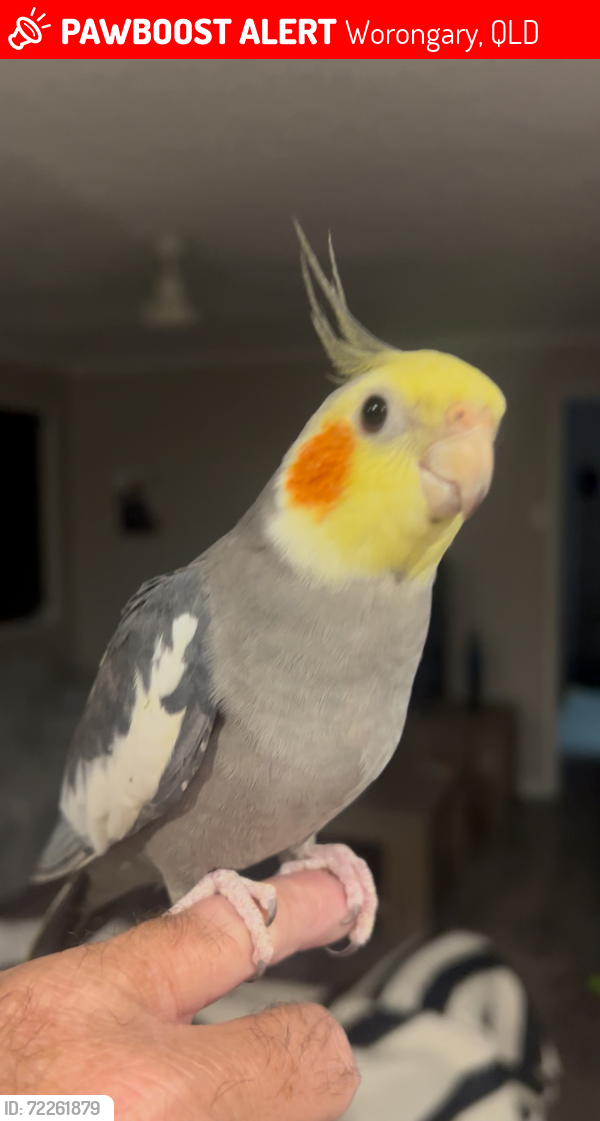
George is Missing in Worongary, QLD

Share on

Status

LOST

Date Last Seen

November 14, 2025

Location Last Seen

Worongary, QLD 4213

Nearest Landmark

Yampi place

Name

George

Sex

Male

PawBoost ID

72261879

Species

Bird

Description

Grey and yellow

Message from Owner

Please help find George. Hand raised and very friendly. Whistles Star Wars and copies other birds.

Facebook Community Response

Ella B.
7 months ago
Lost or free.... thanks for caring
Reply
Cher Y.
7 months ago
FINDING YOUR BIRD Please put your bird’s cage on the verandah in your backyard with food & water and the cage door open. Have you notified all the neighbours in the street and the surrounding streets to contact you if sighted? (Flyers are extremely effective In reuniting pets.) Have you notified all local veterinarians? Please continue reading if interested in more detailed search information. FINDING YOUR LOST BIRD 1. Immediate Response: Timing is critical when you are dealing with a fly-away. To have the best possible chances of recovery, you must spring into action the moment that you discover your bird missing. Use all available people present including whoever can be called in quickly. Delegate tasks so that all immediate steps are happening at once. Immediately assign a few people to scan all nearby trees, poles, and any other obvious perches on your property and the surrounding properties. Have your volunteers examine each tree from 360-degree angles as even brightly-colored birds will be hidden by branches. Delegate someone to collect up all available fishing nets, bird nets, butterfly nets and a few lightweight bathroom towels to hand out. If you can locate the bird, and if you can get it to see you, it may want to fly back toward you; use the towel to throw over the top of it, if you can. 2. Imagining What the Bird Sees: In lucky cases, the bird will be in shock and be too afraid to move at all. In those instances, be sure to keep a close eye on the bird as you try to work out a plan for bringing the bird's cage as close as possible to where the bird is. Birds will usually choose familiar food and shelter whenever they can locate it, as long as the bird understands how to fly down and make a downward landing. And yet many pet birds that have been raised indoors and not in tall trees have never had to learn this s. Some hours of calming and consideration may be necessary before a bird will find the courage to flap down. But often, escaped birds immediately go on the move. Escapes are frantic and birds aren't paying attention to where they're flying. Try to imagine the scene from a bird's eye view. Realize that your bird has never seen where it lives from the air and has no way of identifying where home is. Assuring that your bird maintains non-stop visual contact with you is imperative. Wear brightly colored clothing and use yourself as a slow-moving familiar beacon to urge the bird closer to you and to the cage, which should be brought as close to the bird as possible in the first hours. When the bird has been spotted, arrange a team of people to track the bird's location, around the clock if possible, so that eyes are always on the bird. Don't let the rain discourage you. A bird that has lost sight of anything familiar will begin to search in ever-widening circles, making matters worse. 3. Bringing the Cage Near the Bird: Whenever possible, bring the cage to the bird. For a missing bird, place the cage near the site of the fly-away. If your bird flies out through your front door, for example, place the cage on your porch or doorstep. Whenever possible, hang the cage outside so that it appears just as it would indoors. Add large amounts of your bird's favorite foods and tasty treats in or around the cage to lure the bird back home. Someone should always be at the ready near the cage to pounce with a towel or net. Use large pieces of food that are easily visible, and leave the cage with the door open, possibly rigged with a quick-release trap door latch to quickly lock as soon as the bird enters. 4. Using Familiar Sounds: If you are unable to lure a missing bird back home with cage and food, try "calling" it by name and simply remain in the area, repeating familiar words, sounds, and phrases. In some instances, this may entice your pet to fly down to you. If you regularly play music of a certain type, play some quietly outside. Make it easy for the bird to locate where the sound is originating as a familiar beacon. 4. Casting a Wider Net with Community Help: Sometimes even the best immediate efforts fall short; if you lose visual contact with your bird for most of a day, it's time to launch Plan B. Alert the neighborhood through social media and posted signs, listing your bird's name and description with photos. Request that spotters report immediately any sightings, noting their exact location, and to keep their eyes on the bird until help arrives. Neighborhood kids may love searching for birds, especially is a reward is offered. Alert all local bird clubs, vets, lost and found centers, and list your bird with rescue bird sites that cover your area. 5.!Awaiting Exhausted Birds: Day 1 of freedom for any bird is exciting with much activity. Day 2 will be quieter. No food supply exists for exotic birds in the outdoors, so by Day 3, your bird will be hungry, dehydrated, and exhausted from lack of sleep plus excessive exercise. Birds in this state will often fly to strangers, seeking help from even unfamiliar humans. At this point, they are easily caught. Even after weeks on the loose, birds get retrieved this way, so make sure that all obvious reporting agencies have your contact information. Once home, your tired bird will be so happy to be with you, safe and sound. 6. Preventing Any Escape: An ounce of prevention is worth a pound of cure, so teaching birds some "freedom ss" will make any emergency retrieval faster and easier. Teach your bird to come to your "recall cue," and to fly to a brightly colored "station target" to receive a favorite reward. Also remember to teach the bird to fly down to you from taller and taller perches, door tops, stairs etc. To help ensure that your pet doesn't get lost, post a DO NOT ENTER sign on all doors to warn people when your bird is outside of their cage. When releasing your bird inside the house for a fly around ensure all doors and windows are locked and remain as such until your bird is safely back in their cage. Always feed, change water or clean your bird’s cage inside the home if possible. When the bird cage is taken outside ensure padlocks are placed on all doors. Unfortunately many birds are lost due to the wind blowing cages over and the doors opening. Ensure you snake proof your bird’s cage. Bring your bird’s cage inside at night (if not an aviary) and use a cage cover for sleeping.
Reply
Julie A.
7 months ago
Gold Coast Lost and Found Pets
Reply

More Lost & Found Pets Near Worongary, QLD

More Lost Pets in Your Area
Pawboost White Dog Hero

JOIN THE

RESCUE

SQUAD

The Rescue Squad™ is a group of 7,602,825 pet lovers who have signed up for local lost & found pet alerts.

Join The Rescue Squad™

Contact Owner